Exhibition · 1862–1930
The Modern Line: Meiji & the Birth of Manga
When the Japanese brush met the Western cartoon, a new art was born — and an old word learned to mean something new.
Two Traditions Meet at the Treaty Port
For centuries, Japanese artists had drawn playful, exaggerated, satirical images — from the animal scrolls of medieval temples to the comic *toba-e* prints of the Edo pleasure quarters. Then, in the middle of the nineteenth century, Japan opened its ports to the West, and a second stream of comic art flowed in. In the foreign settlement at Yokohama, European artist-correspondents arrived carrying a specific, potent format: the illustrated satirical magazine, modeled on London's famous *Punch*. It combined the topical political cartoon, the caption, and the recurring visual gag into a printed weekly aimed at a broad reading public.
The collision was generative. The imported cartoon did not simply replace the native tradition, nor did the native tradition simply absorb it. Instead, over the Meiji decades (1868–1912), the two fused. Western draftsmanship, perspective, and the magazine format met the Japanese brush line and its long taste for caricature, and out of that meeting came something genuinely new.
The Word and the Medium
That new thing needed a name. The term *manga* was old — the printmaker Hokusai had used it decades earlier for his sketchbooks of "whimsical drawings" — but it was in the Meiji cartoon boom that the word settled into its modern meaning. Japanese pioneers, above all Kitazawa Rakuten, took the tools the foreigners had brought and built a domestic industry: color satire magazines, salaried cartoonists, recurring characters who returned week after week, and a mass readership that expected them. Rakuten is remembered as the father of modern Japanese cartooning; his contemporary Okamoto Ippei pushed the drawings toward sustained narrative, laying groundwork for comics that told stories rather than single jokes.
This gallery traces that bridge — from the British and French artists who imported the *Punch* format, to the Japanese masters who transformed it into a native mass art. The road runs from these walls straight to the manga of today. That later work remains under copyright and lives on the printed page and the screen, not in this exhibition. What we can show you here are the roots: the moment a global cartoon language and an ancient brush tradition became one line.
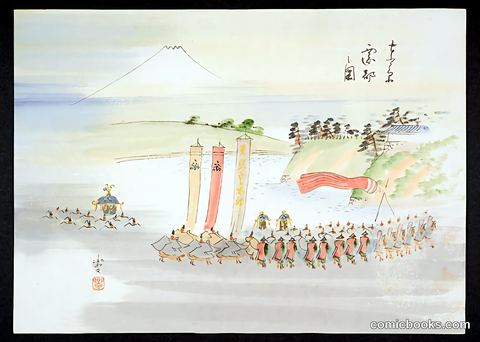 A Kitazawa Rakuten cartoonKitazawa Rakuten c.1900–1928
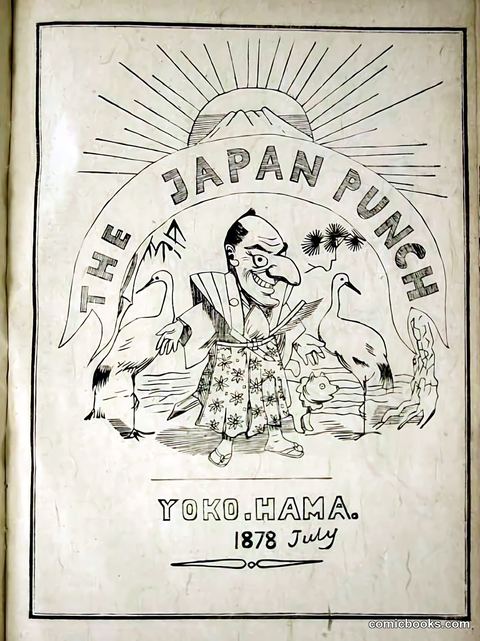 The Japan PunchCharles Wirgman 1862–1887
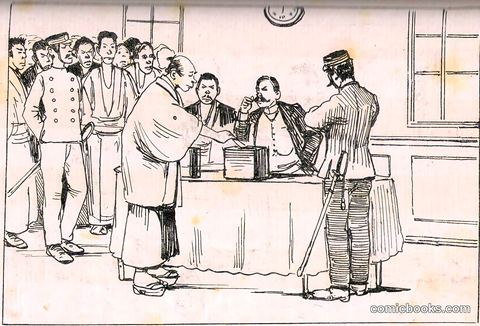 Meiji satire (Tôbaé)Georges Ferdinand Bigot 1887–1899
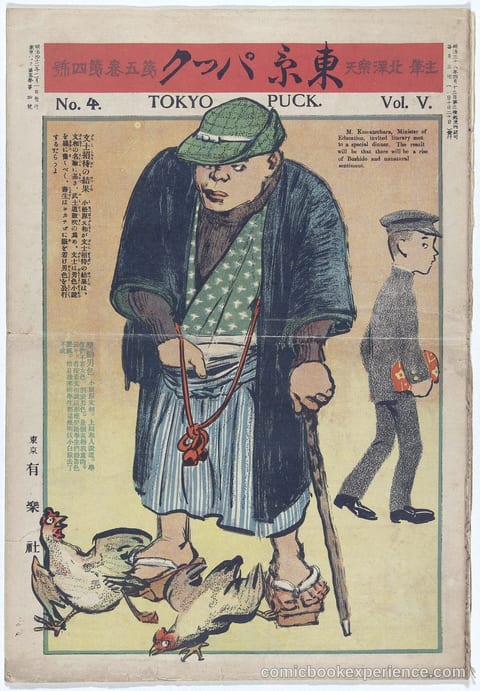 Tokyo PuckKitazawa Rakuten 1905–1912
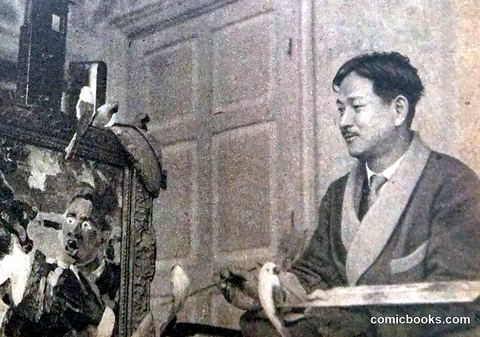 Comic-strip mangaOkamoto Ippei 1910s–1920s
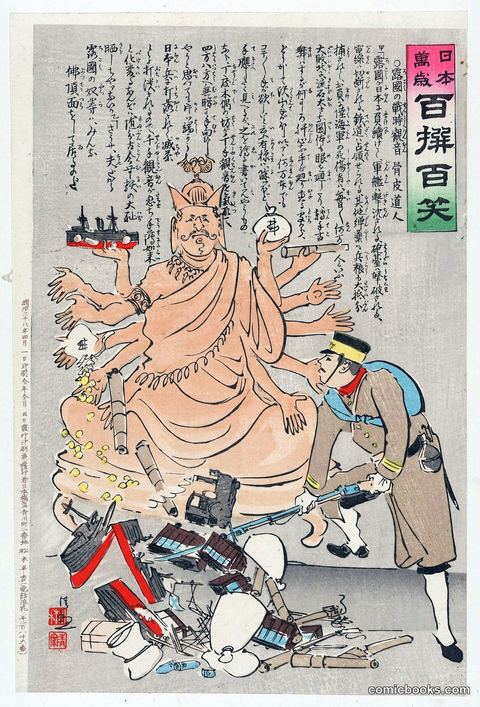 Meiji satirical printKobayashi Kiyochika 1890s