From the exhibition
De Toverlantaarn (The Magic Lantern), Part 3
· circa 1720
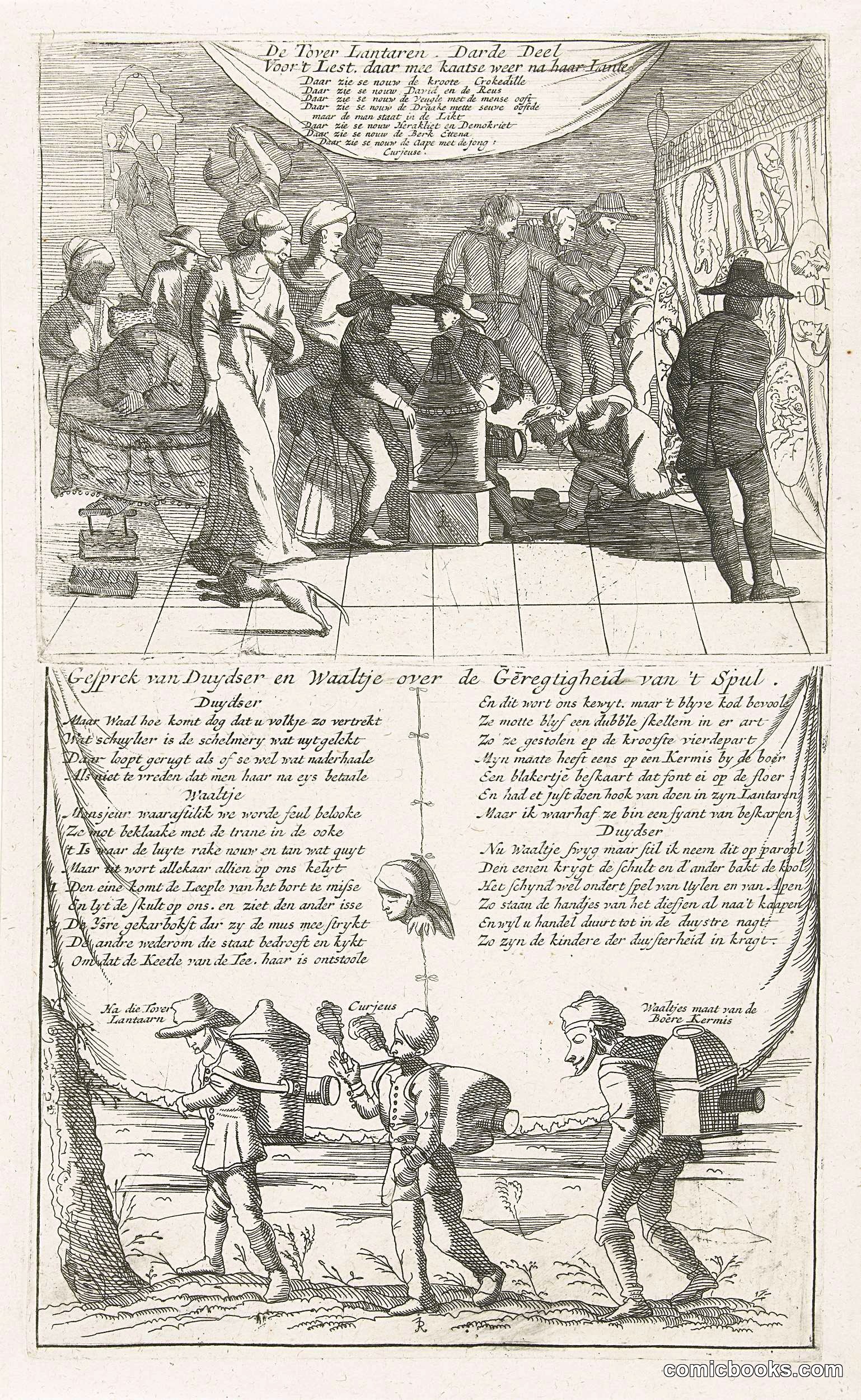
This Dutch engraving satirizes social folly through paired scenes: an upper chamber where figures of rank engage in deception and intrigue, and a lower panel showing common folk duped by a charlatan's tricks. The print exemplifies early 18th-century moral satire, where hierarchies of class become targets for ridicule. The artist employs the engraver's fine crosshatching to render costume, gesture, and expression with caustic precision. Such broadside prints, distributed widely and often accompanied by moralizing verse, established conventions—stock types, exaggerated physiognomy, narratives of vice and folly—that would migrate into the sequential storytelling of later comic traditions. Here, the "magic lantern" serves as metaphor: society itself is revealed as illusion and performance, its pretenses stripped bare.
Public domain, restored and presented by comicbooks.com http://creativecommons.org/publicdomain/mark/1.0/